 |
| he Thesion from the ancient Agora, Athens |
Day
46 Thu 10 July ATHENS
A free day in Athens to visit the Acropolis (if you
haven’t already done so) or go up the Likavitos by funicular – I believe you
get great views of the city from there. There is also the Archaeological Museum,
Temple of Olympian Zeus and the old Olympic Stadium, built for the first modern
Olympic Games in 1896, near Constitution (Syntagma) Square. If you would like
something different, a day trip from Piraeus (port of Athens easily reached by
railway) to the nearer Islands (Aegina, Poros and Hydra) of the Saronic Gulf is
recommended. Ferries run regularlyand can be organised via the Hotel or the Tourist Office in Syntagma Square.
 |
| Donkeys wait patiently by the harbour at Hydra, one of the Saronic Islands |
Day 47 Fri 11 July ATHENS
 |
| Agia Dynami Church is central Athens |
I have now been advised that we have a problem with visas for Syria. From 1st
July the Syrians have decided that we now have to obtain entry visas in advance to pass
through their country. Up until now, we have always been able to obtain the visas at
the border. We will now be spending an extra day in Athens while we try to sort
this out with the help of our Greek representative. As it is Friday and the
Syrians officially are an Islamic nation, they will probably be observing
‘mosque day’ and, of course, it is then the weekend, so if I have no luck this
morning, I will have to get these visas in either Istanbul or Ankara. As you walk around Athens you may have noticed a rather unusual little church, tucked beneath the Greek Education Department building. This is the 16th century Agia Dynami, or Holy Power, Church believed to have been the site of an earlier Temple of Hercules. It is believed that if pregnant women visit this little church they will give birth to strong children. There is also a complex of ancient tunnels leading from a cave beneath the church which were used for smuggling weapons from a nearby arms makers during the Greek War of Independence (1821-29).
This
afternoon, for those interested, we will go on an excursion to Marathon where a decisive battle
between the Athenians and Plateans, on one side, and the Persians on the other,
was fought in 490 BC. The Persian invaders under Darius I were intent on the destruction of Athens, the subjugation of the various Greek city states and the extension of the Persian Empire
into Europe. For several days the two armies faced each other, the Athenians cutting down trees and building stockades close to the Persian lines.  |
Phillippides brings news of the victory to Athens
painting by Luc-Olivier Merson (1846-1920) |
They also
sent Phillippides to ask for help from the Spartans. This prototype Marathon-runner covered the 100 miles
of broken country in two
days – but Spartan help arrived too late -
and then ran back to Marathon. One night the Athenian commander was
informed by Ionian spies, that the Persian cavalry was away from their camp,
Seizing the opportunity, the Athenians and the Plateans attacked at once. In
the furious fighting that followed, the Persians
were driven to their ships, sailing off towards Euboea Island. According to
legend, Phillippides was asked to undertake one more run – to Athens, some 42
kms away - the distance of a
modern Marathon – to carry news of the victory. He is said to have arrived at
the Greek parliament, uttering “We win!” then collapsed and died of
exhaustion.  |
| The burial mound at Marathon - Wikipedia |
By the flashing of sunlight on a shield from Euboea, the
Athenians learnt that the Persian fleet had changed course and was making for
Athens. By a classic forced march, the Athenian army reached the city just
before the Persian fleet, thus deterring a landing and so, Athens was saved from
the Persians for the next 10 years. The
city was sacked by Xerxes in 480 BC before he, in turn, was defeated by the Greeks in the naval battle in the bay of Salamis. On
the road to the beach is the burial mound of the Athenians and Plateans who fell
and a small museum. We will also stop for a time on Marathon Beach.
Day 48 Sat
12 July ATHENS – DELPHI – METEORA
Departure time: 7.30am Tach reading: 130,369 Distance run: 408 kms
As i have heard
from two reliable sources that we can definitely get Syrian visas in Istanbul,
we will head off to Meteora via Delphi.
 |
| The theatre at Delphi |
Delphi is the site of the ancient Oracle of
Apollo, god of prophecy, which all ancient Greeks consulted before doing
anything of consequence. This spectacular site in the Parnassos Mountains was
considered by the Greeks to be the ‘omphalos’, or ‘navel’ of the earth, decided
after Zeus, king of the Olympian gods, released two eagles to fly around the
world in opposite directions – they met over Delphi. Originally the site was a
sanctuary to the earth-mother Ge (Gaea) and was guarded by the great snake,
Python. Apollo, shortly after his birth, wandered here, killed Python and
became the leading god of prophecy to the Greeks.
 |
| Treasury of the Athenians, Delphi |
A great Temple to Apollo was
built here and the prophetess (Pythias as they were known), the mouthpiece of the
god, sat on a tripod over a deep crevasse from which emanated fumes. Entering a
trance the Pythia would utter her prophecies which were interpreted by the
priests. These prophecies were known for there ambiguity. Three well-known
prophecies: i) Croesus, king of Lydia, consulted the oracle during his war
against the Persian king Cyrus. He was told “If Croesus crosses the river
Aly, he will destroy a great kingdom”. Croesus crossed the river and the
‘great kingdom’ that was destroyed was his own. ii) the Greek commander
Thermistocles was told, during the Persian invasion of Xerxes, to take to his ‘wooden
walls’, which the Greeks interpreted as meaning their ships. The result was
the Greek naval victory over the Persians in the straits of Salamis. iii) Byzas, a
Greek trader, decided to establish a trading settlement and was told by the
Pythia to go opposite the ‘land of the blind’. His settlement became
known as Byzantium, later Constantinople and, today Istanbul. The ‘blind’ were
the people then living on the Asiatic shore of the Bosporus, who must have been
‘blind’ not to use the choice peninsula between the Sea of Marmara and
the Golden Horn where Byzas established his trading settlement.
By
the early years of the Christian era, the influence of the Oracle was waning,
especially after Constantine the Great, in the early 4th century,
adopted Christianity as the official religion of the Roman Empire. One of his
successors, Julian the Apostate, later in the 4th century attempted
to revive the old religion and sent an envoy, Oreibasius, to consult the
Pythia: Tell
the king, the fairwrought hall has fallen to the ground, no
longer has Phoebus a hut, nor a prophetic laurel, nor
a spring that speaks. The water of speech even is quenched.
This
answer is possibly apocryphal, but ‘expresses an unquestionable truth: the
death of Apollo’s cult and the downfall of his sanctuary.’ (Basil Petrakos – Delphi).
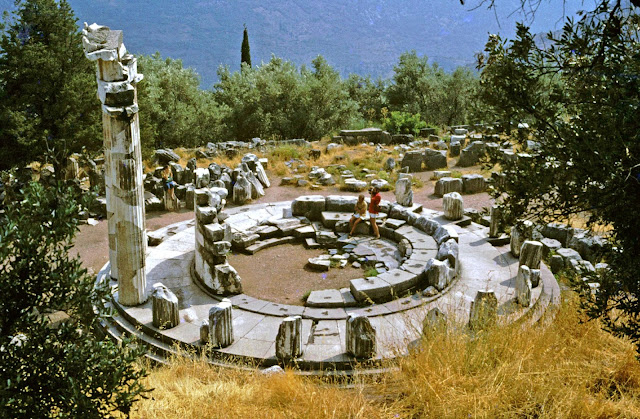 |
| The circular Tholos, in the Sanctuary of Athena Pronaia, Delphi |
Today, there remains the ruins of the Temple of
Apollo, the Treasuries, particularly that of the Athenians, the theatre and the
stadium, plus an excellent Museum. Nearby is the Castallian Spring where the priests
and pilgrims would bathe before consulting the oracle and whose waters the
Pythias would drink. Below the road is the famous circular temple known as the
Tholos, in the Sanctuary of Athena Pronaia.
From Delphi we press on along winding mountain roads before finally dropping down to Lamia, then after crossing another range of hills, we reach the fertile plains of Thessaly and Meteora, the geological phenomenon of
Greece.
 |
| Meteora, the 'Rocky Forest of Greece' |
These unique pillars and towers of river-deposited debris have been
eroded into fantastic shapes and have become a refuge for monks and ascetics of
the Byzantine, or Greek Orthodox, creed who have built monasteries on the top of
many of these formations over the last 500 years or so. The name, Meteora, means
‘suspended in the air’ and the area is delightfully described by Sister
Theotekni, a nun of the Eastern Orthodox Church, in her book Meteora, the
Rocky Forest of Greece: “A strange, mythical forest consisting of over 1000
enormous stony bodies, some huge and wide, others small and meagre like
skeletons but all of them with their summits in the sky, of some other
superworld. The trunks that make up the
forest remind one of petrified mythical giants, but the churches’ domes and the
ringing of their bells inform you that this is holy property: it is “the stony
forest of Jesus”!
Tonight,
our first night camping, will be spent in a small camping ground near the
village of Kastraki, known as Camping ‘The Cave’ . Here we are often joined by the locals for a few wines, or ouzos!
Day 49 Sun
13 July METEORA – KAVALA
Departure time: 8am Tach reading: 130,777 Distance run: 413 kms
 |
| Rousanou Monastery, Meteora |
On leaving Camping ‘The Cave’ this morning we will
drive up into the rocks of Meteora, stopping first for a photo of the
spectacular Rousanou Monastery, balanced precariously on a rock, sheer on three
sides. Next we will stop at the Monastery of the Transfiguration, or Grand
Meteoron. This is the largest Monastery and it is from this rock that the whole
area takes its name. Nearby and just below is the Varlaam Monastery, named
after the first hermit who built a chapel here in the 14th century.
The Monasteries do not open until 9, and you have a choice of going into one or
the other. We will also stop near the Monastery of the Holy Trinity for a photo
stop. This is one of the most photographed monasteries in Meteora. The
Monastery itself is not open to the public.
 |
| Varlaam Monastery, Meteora |
From
Meteora we will push on to Larissa where we join the main road north to
Thessaloniki. The road travels through the Tempe Valley following the River
Pineios, personified as the river-god Peneus. This area, beneath Mt Olympus, is
rich in mythological traditions, being the setting of several of the great god
Zeus’s amorous escapades hidden, he hoped, from the watchful eyes of Hera, his
wife. Here also in the Tempe Valley, the nymph Daphne, to escape the seductive
advances of Apollo, was transformed into a laurel tree by her river-god father, Peneus. Mt Olympus itself was the perpetual abode of
the main ancient Greek gods, the Twelve Olympians, under Zeus. From the Tempe Valley we
pass by Platamon and on to Thessaloniki, the second city of Greece, often
referred to by the English name, Salonica, where we will stop for lunch. From here to Kavala is 160 kms of winding
road. Tonight and tomorrow we will be staying in Camping Akti Kavalas.
 |
River Pineios in the Tempe Valley & 15th century painting by Piero del Pollaiuolo of
Daphne, daughter of the river Peneus turning in a laurel tree under the unwanted advances
of the god Apollo
|
Greek Mythology |
| Mt Olympus, home of the major Greek Gods, presided over by Zeus & Hera |
In the beginning there was nothing but Chaos – a
huge dark mass where everything was hidden. Out of Chaos came the goddess Ge,
or Gaea (Earth) and the gods Uranus (Heaven) and Pontus (Sea). It was from
these three that the ancient world was peopled. Most important were the
children of Ge and Uranus – the 12 Titans, the one-eyed Cyclops and the
hundred-handed Hecatoncheires. Uranus hated his children and banished them to
the Underworld, but one of the Titans, Cronus, on Ge’s instigation, rebelled,
wounded and imprisoned Uranus, thus becoming king of the gods. Cronos married a
female Titan called Rhea, but having been told in a prophecy that he would one
day be deposed by his son, Cronos swallowed each of his children (including the
females) as soon as they were born with
the exception of the youngest son, Zeus. Rhea wrapped a rock is swaddling
clothes which Cronos swallowed. One day when Zeus had reached manhood, Rhea
gave Cronos a potion which made him regurgitate the swallowed children –
Hestia, Demeter, Hera, Hades and Poseidon who, along with their children,
became the main gods of the Greek pantheon. Thus Cronos was cast down and Zeus
became the king of the Gods, establishing his palace on Mt Olympus. The Titans
and other giants were banished to the Underworld after fierce fighting and Zeus
reigned supreme.
The
Greek religion was, of course, polytheistic in which each god served a purpose,
looked after different aspects of everyday life and was consulted before any
important decisions were made. Below are some of the gods and their functions,
also their Roman names as early Rome adopted the Greek religion. There are some similarity to these gods and those of the Hindus which possibly relates to the Indo-European origins of both the Vedic Hindus and the Achaean Greeks.
Greek name Function Roman name
The Twelve Olympians
Zeus king
of the gods, lord of the thunderbolt Jupiter
Hera goddess
of childbirth, marriage, women Juno
Poseidon god
of the sea & eathquakes Neptune
Demeter goddess
of agriculture Ceres
Apollo god
of prophesy, healing, music & the sun Phoebus
Ares god
of war Mars
Aphrodite goddess
of love Venus
Hephaestus god
of fire, volcanoes Vulcan
Artemis goddess
of the moon, hunting, forests Diana
Athena goddess
of wisdom, purity & liberal arts Minerva
Hermes god
of travellers, messenger of the gods Mercury
Dionysus god
of wine, vegetation & fertility Bacchus
Other Important Gods & Goddesses
Hestia goddess
of the hearth Vesta
Hades god
of the underworld Pluto
Eros god
of love Cupid
Eos goddess
of the dawn Aurora
Persephone goddess
of spring Proserpine
Asclepius god
of medicine Aesculapius
Pan god
of flocks, countryside, nature Faunus
Hypnos god
of sleep Somnus
Eris goddess
of discord & strife Discordia
Day 50 Mon 14 July KAVALA
 | | Fishing boats along the waterfront at Kavala |
|
A free day to spend either at the campsite on Batis Beach, in the fishing town
of Kavala, or over on the Island of Thassos which is about an hour’s voyage by
ferry. Kavala is an important and most attractive fishing port on the
Northern Aegean coast of Greece. The area has been settled since around 3000 BC and the first port was built here in the 5th
century BC. Kavala was the first city in Europe to receive the teachings of St.
Paul and for a while was known as Hristopolis (city of Christ). The town was
captured by the Ottoman Turks in 1380 and remained under Ottoman control until
1913. Nowadays Kavala is an important fishing and tourist town. Things to
see are the Ottoman aqueduct, the Byzantine Castle and the birthplace of Muhammed
Ali, the Egyptian Mameluke leader of the early 1800s.
Comments: STOP PRESS
The
Police in Kavala are still trying to solve the mystery of the
broken telephone in the Tourist office. Apparently
there is a substantial reward offered to anyone who can
provide vital information leading to the capture of the culprit!!
Gods & Goddesses of P48
John Papple destroyer
of telephones Woodpile
Lindsay Clark insults
& bad jokes Guru
Ken good
times & hangovers Carol
Sam god
of complaints Pissed off
Terri goddess
of cheese Swissgirl
Frank god
of sleep & lord of the supper table Bo-Doe
Canadian John god
of numbered shirts 50
Rolf god
of beards Mr Neil
Ian god of passports &
travellers cheques The
Thomas Cookie Monster
Katie,
Juliette & Jane goddesses of
the fast pick-up The Three Fates
Bookseller god of belly dancing Eroticus
Pippa pig goddess Oink
text & photographs ©Neil Rawlins
|


