Featured post

Overland to London - Ephesus to Anzac Cove

  Celsus Library, Ephesus Day 87 (London Day 3)    Wed 20 August     EPHESUS – ANZAC COVE After a night-drive through from Pamukkale we a...

Thursday, 12 August 2021

Overland to London - Delhi via Amritsar to Jammu


A Punjabi farmer ploughing his land


Day 14    Sun 8 June           DELHI – AMRITSAR

Departure time:  8am                 Tach reading  133,649          Distance run: 444kms                                   


               This morning we leave Delhi and head north, through the State of Haryana, passing through the towns of Panipat, scene of a great battle when Babur, the first Moghul Emperor, defeated the Lodi princes and captured India for the Moghuls, Ambala and, after entering the Punjab, Ludhiana.  We will be driving along the famous Grand Trunk (GT) Road, an ancient road dating at least from the Mauryan Empire in the 3rd century BC which originally ran from Chittagong, now in Bangladesh, to Kabul in Afghanistan. The section of road that we will be driving along was described eloquently by Rudyard Kipling in Kim: "And truly the Grand Trunk Road is a wonderful spectacle. It runs straight, bearing without crowding India’s traffic for fifteen hundred miles in such a river of life as nowhere else exists in the world. ... They met a troop of long-haired, strong-scented Sansis with baskets of lizards and other unclean food on their backs, the lean dogs sniffing at their heels. These people kept their own side of the road. moving at a quick, furtive jog-trot, and all other castes gave them ample room; for the Sansi is deep pollution. ..." 

Both Ambala and Ludhiana have busy railway stations which are always interesting to visit, if we have time. It is said that the Indian Railways are a complete microcosm of Indian life, and the trains are always overloaded. Mahatma Gandi aptly described some of the horrors of rail travel in his monograph Third Class In Indian Railways: "The closets attached to these places defy description. I have not the power to describe them without committing a breach of the laws of decent speech. Disinfecting powder, ashes, or disinfecting fluids are unknown. The army of flies buzzing about them warns you against their use. But a third-class traveller is dumb and helpless. He does not want to complain even though to go to these places may be to court death. I know passengers who fast while they are travelling just to lessen the misery of their life in the trains.”  

Ludhiana railway station, Punjab

Always room for one more on an Indian train

    The Punjab means the ‘land of the 5 rivers’ – Sutlej, Ravi, Beas, Chenab and Jhelum, all tributaries of the Indus -  and Amritsar is the State capital. The Punjab is now divided between Indian and Pakistan, a result of the 1947 Independence partition. This act and its subsequent International boundary, known as the Radcliffe Line, brought much bloodshed and heartbreak to Hindu, Sikh and Moslem communities on both sides of the new border. Some 10,000,000 people were uprooted and emigrated to one country or the other. The Punjab is now one of the most prosperous of the Indian states, often being referred to as the breadbasket of India, due to the amount of wheat grown here.

    Amritsar is the capital of the Indian Punjab and is now a thriving city close to the border with Pakistan. In 1919 a British General Dyer ordered the shooting of a large, peaceful crowd that had gathered in Jallianwala Bagh to protest against the arrest of pro-Indelendence leaders. Over 1000 protesters were killed and as many injured. The shooting only stopped when Dyers' force, mainly Gurkhas, Pathans & Baluchis, ran out of ammunition. This incident shocked the British and some consider it a decisive step towards the end of British rule in India. Jallianwala Bagh is now a pleasant garden not far from the Ritz Hotel where we will be staying.

Jallianwala Bagh, site of the 1919 Amritsar massacre


Street scene with Police 'Beat Box', Amritsar

Amritsar, or ‘Pool of Nectar’ is the holy city of the world’s youngest major religion – Sikhism – which was founded in the 16th century by Guru Nanak. Nanak travelled widely and studied all religions before he made the pronouncement: "i shall follow God's path. God is neither Hindu nor Mussulman and the path which I follow is God's." A popular story told about Nanak was that when he was in Mecca, he was found sleeping with his feet towards the Kaaba. A Moslem kazi who saw him, angrily objected. Nanak replied asking the kazi to turn his feet in a direction in which God or the House of God is not. The kazi understood the meaning of what the Guru was saying - "God is everywhere".

The entrance to the causeway to the Golden Temple

The city is built around the famous Golden Temple, situated in the ‘Pool of Immortality’ and, all being well, we will visit the temple tonight to see the daily ceremony in which the holy book, the Adi Granath, the final and eternal Guru, is packed away – ‘putting the book to bed’ -  and taken in ceremony to its nightly storage place in the Akal Takht, a five-tiered marble building at the ‘Pool’ side.   

The Akal Takht and the Golden Temple, the 'Abode of God', in the Pool of Immortality

Pax comments:  
                 We all live in hope of the day when Lindsay may surprise us all by saying something intelligent

                      “It is better to remain silent and be thought a fool, than to speak and remove all doubt.”


Day 15    Mon 9 June           AMRITSAR – JAMMU

           Departure time:  8.30AM                  Tach reading:  134,093          Distance run: 206 kms

       There is One God                                                                                                                       He is the supreme truth                                                                                                              He, The Creator                                                                                                                          Is without fear and without hate                                                                                                  He, the Omnipresent                                                                                                                    Pervades the Universe                                                                                                                He is not born                                                                                                                              Nor does He die to be born again                                                                                                By His grace shall thou worship Him

          Thus begins Jupji – the Sikh morning prayer. Sikhism is regarded as the world’s newest religion, first being preached by the Guru Nanak in the early part of the 16th century. Nanak rejected the formalism of both Hinduism and Islam and preached a gospel of universal toleration that emphasised the fundamental truths of all religions. Guru Nanak composed the Jupji, the first few lines of which, known as the Mool Mantra, is called the basic belief. Sikhism started out as a way of life rather than a religion, but as it developed through the succession of Gurus, persecution by the Moghuls forced the Sikhs to develop into a close-knit community and eventually the massacres of Aurangzeb at the time of the 10th and last Guru, Govind Singh, to arm the Sikhs. It was Govind Singh who gave them the ‘5 Ks’: i) Kesh – hair which was never to be cut ii) Kangha – the comb with which the hair was to be groomed at least once a day. iii) Kachha - undershorts, so that they would never been seen naked iv) Kara – the steel bangle all Sikhs wear and v) Kirpan -  sword or dagger to defend oneself.

Sikhs at the Golden Temple - note the different styles of turban

          From this time on Sikhs began to defend themselves against the Moslems, harassing the Moghul armies with guerrilla tactics, but it was Ranjit Singh, the one-eyed ‘Lion of the Punjab’, who finally organised them into a strong army and conquered large tracts of the Punjab and present-day Pakistan in the early 19th century, until they were defeated in two wars by the British. The name Singh, that every Sikh has after his name, means ‘lion’ and was given to them by Govind Singh. Today, Sikhs form some of the best units in the Indian Army.

Early morning by the Pool of Immortality, Amritsar


          Amritsar, the Sikhs’ holy city developed around the Golden Temple (Sri Harimandir Sahib – “abode of God”). The Golden Temple is not only a central religious place of the Sikhs, but also a symbol of human brotherhood and equality. Anyone, irrespective of cast, creed or race, can seek spiritual solace and religious fulfillment without any hindrance. The Temple rests in the ‘Pool of Immortality’ and there is a Sikh community-run kitchen that serves a free simple vegetarian meal to all visitors. The Temple complex, particularly the Akal Takht, was badly damaged in 1984 after demands to create an autonomous Sikh state was suppressed when Prime Minister Indira Gandhi sent the Indian Army (Operation Blue Star). The aftermath led to Indira Gandhi’s assassination on 31 October 1984.

The Golden Temple, Sri Harmandir Sahib, in Amritsar

          The drive from Amritsar, via Batala, Gurdaspur and Pathankot, to Jammu, in the disputed (with Pakistan) State of Jammu and Kashmir, is relatively short – about 6 hours. Once again we come close to the Himalayas, although Jammu is still on the plains. We stay tonight at the Jammu Motel.


Text & photographs ©Neil Rawlins 


Instagram accounts  @dustonmyfeet     and    @antipodeanneil

My paperbacks and ebooks on my Overland travels in Asia, Europe & Africa in the early 1970s and the experiences of a tour guide on the Asian Overland routes & leading Camel Safaris in Rajasthan in the 1980s are available from Amazon.


Overland to London - Jaipur to Delhi


Morning reflection of Jal Mahal, the Water Palace, on the road to Amber

Day 11    Thu 5 June           JAIPUR – DELHI

Departure time: 8.30AM              Tach reading  133,326            Distance run  252kms

We leave Khetri House at 8.30 with Eugene for the short drive to the remarkable Amber Fort and Palace in the nearby Aravalli Hills.

The Amber Fort & Palace

The Amber Fort we see today was built  by the Kachwaha Rajputs in the 16th century on the site of an earlier fortification. Moghul architecture greatly influenced the architectural style of several buildings in the Fort, including the Diwan-i Aam (Hall of Public Audience) and the Diwan-i Khas (Hall of Private Audience).  Amber was the capital of the present Jaipur region from the 10th century and when its spectacular position in the Aravalli Hills became to small for the expanding population, Maharajah Sawai Jai Singh II founded modern Jaipur and moved the capital there in 1727. There is a fairly steep climb up to the fort from the bus park, but you can ride an elephant up at a cost of 13 rupees.

The main courtyard & columns of the Baradari Pavilion, Amber Fort

Ganesh Pol, the entrance to Maharajahs' rooms of Amber Palace & delicate marble inlay work

    The Palace at Amber has some incredibly detailed frescoes, sculptures and inlay work. The richly decorated Ganesh Pol is the entrance to the private palaces of the former Maharajah and dates from 1621-27. The Diwan-i Aam has 27 columns with elephant-shaped capitals. 
Mirrored ceiling of Sheesh Mahal


But perhaps the highlight is the Sheesh Mahal, or Palace of Mirrors, built by Maharajah Man Singh in the 16th century. The walls and ceiling and covered with mirror mosaics and coloured glass and at night were a "glittering jewel box in flickering candlelight." Unfortunately over the years unscrupulous visitors have picked out many of the lower mirrors, and just one man is currently skilled enough to replace them. 
Eugene will explain in some detail the uses of the different buildings within the ancient city walls and tell us the history of Amber. 

High on a promontory, known as the Cheel ka Teela or Hill of Eagles, overlooking Amber Palace is the Jaigarh Fort, built in 1726 by Jai Singh. Although not currently open to the public (in 1980), Jaigarh Fort, in its day,  had one of the world’s most efficient cannon foundries.  Jaigarh is connected to the Amber fort by an underground tunnel which was built as an escape route to enable members of the royal family to move to the more defendable hilltop fort in time of war.
We will take our leave of Eugene here at Amber  and after lunch drive on to Delhi where we will be staying at the Ranjit (Rat-shit) Hotel. It's not as bad as its nickname makes out!

The nut & spice seller in the courtyard of Amber Fort


COMMENTS from passengers:  Gopher seems to be in for a lot of verbal comments today! Could it have something to do with the watermelon punch or, perhaps, a rather tasty cookie?

          The Queen of Hearts brought some tarts, but the picnic is cancelled due to unexpected monsoon.


Day 12    Fri 6 June                  DELHI

Departure time: 9AM                    Tach reading: 133,538            Distance run: 71kms                         

This morning our guide, Captain Vohra (ex-Indian Army), will meet us at the hotel and take us on a half-day tour of the Indian Capital. First stop will be the Lakshmi-Narayan Hindu Temple (Birla Mandir), opened by Mahatma Gandhi in the 1930s. All materials used and craftsmen involved in the construction were from India and the contemporary art work is rather interesting.

Lakshmi-Narayan, or Birla, Temple; Qutb Minar & the unfinished Alai Minar 

    From Birla Temple, the Captain will take us through the Parliament area of New Delhi to the Secretariat and the President’s House, designed early in the 20th century by the British architects, Sir Herbert Baker and Sir Edwin Lutyens. In fact all of New Delhi was laid out by the British specifically to be the capital of British India and on December 23 1912, the capital was moved here from Calcutta. The President’s House was originally the Viceregal Palace. The current President of India (1980) is Neelam Sanjiva Reddy.

Indian Army Lancers at the Presidents House, New Delhi

After passing through the diplomatic area we come to the original site of Delhi and the oldest Moslem remains in the area. Here is the famous Qutb Minar, the world’s largest minaret, and the ruins of the unfinished Quwwat-ul-Islam, or Might of Islam Mosque both of which date from the late 12th century. Here also is the Rustless Iron Pillar that Erich von Daniken, a Swiss writer who theorised that there was extraterrestrial influences on ancient civilisations, recently made a big fuss of, claiming it was made of ‘unknown alloys’. The pillar is 99.9% pure iron and dates from the reign of Chandragupta II in the early 5th century AD. This fine piece is a tribute to the skill of the ancient Indian metallurgists and certainly didn’t come from outer space as von Daniken claimed. In fact, he did concede he was wrong in a later interview with Playboy Magazine saying, rather flippantly, of the ‘Rustless’ Iron Pillar: “we can forget about this iron thing.”

The Rustless Iron Pillar from Qutb Minar & the Courtyard

From the Qutb Minar we head back to Old Delhi via Raj Ghat where Matahtma Gandhi was cremated after his assassinated in Delhi in early 1948. We then continue past the Red Fort to Connaught Circus, the commercial centre of New Delhi and back to the Ranjit Hotel. Afternoon and all tomorrow is free time.

Buildings in Connaught Circus, the centre of  New Delhi

Day 13    Sat 7 June                 DELHI


          Today is free to shop or sight-see further. Places to visit include Delhi Zoo with its white tigers; Chandni Chowk, the crowded shopping street of old Delhi; the Jama Masjid (Great Mosque); the 17th century Red Fort of Delhi, commissioned by Shah Jahan; Ferozshah Kotla, the 14th century fort with an Asokan Pillar and the 16th century Purana Qila, or old palace. 

Old Delhi from a minaret of Jama Masjid, the Great Mosque

The Jama Masjid, one of the largest mosques in India, was built on the orders of Shah Jahan between 1650 and 1656 at a cost of one million rupees, and was to be the focal point of Shahjahanabad, his new capital. Jama Masjid is one of the best examples of a blend of white marble and red sandstone in the Islamic world.

The Ashokan column atop 14th century Ferozshah Kotla

Ferozshah Kotla fort was built by Sultan Firoz Shah Tughlaq who ruled Delhi from 1351 and 1388. The Ashokan Pillar dates from the 3rd century BC and was moved to its present position in 1356. The Pillar has what is prehaps the best know of Ashoka's decrees: 'Along the highroads I have caused fig trees to be planted that they may be for shade to animals and men...'

16th century Purana Qila, the Old Fort built by Humayun

Purana Qila means the 'Old Fort' and was constructed by Moghul Emperor Humayun in the first half of the 16th century on what was said to be the site of Indraprastha, the city of the legendary Pandavas whose story is told in the epic Mahabharata. 

It was in Purana Qila that the second Moghul Emperor, Humayun, tripped on his robes while he was answering the call to prayer, and fell to his death in 1556. 

The beautiful Tomb of Humayun, built in the late 16th century

The Tomb of the second Moghul Emperor Humayun was commissioned by his first wife and chief consort, Empress Bega Begum. Designed by Persian architects, this was the first garden-tomb to be built on the Indian sub-continent.

Jai Singh Ii's Delhi Observatory; white tiger at Delhi Zoo & a place of quiet contemplation 

Emperor Sawai Jai Singh II of Jaipur's Delhi observatory is not quite as complex as that in Jaipur but still worth a look around - if you can find it.


St. James, or Skinner's Church, one of the oldest in Delhi

Near the Kashmir Gate in old Delhi is St James Church, better known as Skinner's Church.  The Church was built between 1826 & 1836 by the Anglo-Indian Colonel James Skinner, Sikandar Sahib, who, in the early 19th century raised two regiments of irregular cavalry for the East India Company which became known as 'Skinner's Horse' which are still units of the Indian Army. The Church was, for a number of years, the church of the Viceroys and a number of prominent British administrators and soldiers, including Skinner himself, are buried in the Churchyard.

      This evening I will arrange a meal of tandoori chicken at Moti Mahal, a popular restaurant in Old Delhi, then we will visit the ‘Sound and Light’ show at the Red Fort.

 PASSENGER COMMENTS:  Got a good run for our money at Moti Mahals!!!


Text & photographs ©Neil Rawlins 


Instagram accounts  @dustonmyfeet     and    @antipodeanneil

My paperbacks and ebooks on my Overland travels in Asia, Europe & Africa in the early 1970s and the experiences of a tour guide on the Asian Overland routes & leading Camel Safaris in Rajasthan in the 1980s are available from Amazon.


Tuesday, 10 August 2021

Overland to London Agra to Jaipur


The skyline across Fatehpur-Sikri
Day 9     Tue 3 June           AGRA – JAIPUR

Departure time: 8am               Tach reading: 133,058            Distance run: 259kms

We leave Agra this morning, with our guide, for Fatehpur-Sikri, the red sandstone city of the Moghul Emperor Akbar the Great, built in the countryside some 20 miles from Agra. This city was built by Akbar on the spot where an elderly dervish, Sheikh Salim Chishti, had lived. This Moslem saint had bestowed blessings on Akbar and his wife when no heir to the throne had been forthcoming. After Akbar’s Hindu wife gave birth to prince Salim, latter to become Emperor Jahangir, Akbar decided to move his capital and court to the site of a completely new city. Fatehpur-Sikri was built in 7 years at the place where Shaikh Salim lived. Craftsmen and artisans from all over Asia were brought in and, for 17 years, the city flourished until what is believed to be a lack of an efficient and regular water supply, and also Moghul military campaigns,  took Akbar away to Lahore. The city was subsequently deserted, leaving behind what is now a remarkable monument.

Exterior city walls & the Buland Gate & courtyard, Fatehpur-Sikri

The marble Tomb of Sheikh Salim Chishti & carved red sandstone panels

After Fatehpur-Sikri we will head into Rajasthan, to Bharatpur and the Keolodeo Ghana National Park, which was once the shooting preserve of the local Maharajah and is now a bird sanctuary of international renown. Depending on conditions and timing, we may have lunch here.

'Kill' Board from the days of the Raj & painted storks in the Keolodeo Ghana Bird Sanctuary, Bharatpur, Rajasthan

    During the days of the British Raj, many British administrators and visitors were hosted by the Maharajah of Bharatpur for 'shooting parties'.  The 'kill' boards  are horrendous, thousands of birds were killed just to boost the egos of the 'aristocracy' of the Raj. For example on 3rd December 1914, the 49 guns of Viceroy Lord Harding's party 'bagged' 4062 birds. On 20 November 1916, the 60 guns of Viceroy Lord Chelmsford's party 'bagged' 4200 birds - mainly ducks but presumably also all other species, and on 8 December 1922 the 53 guns of the 2nd shoot of the Prince of Wales party; bagged' 2221 birds. Fortunately for the birds, the killing slowed down after Independence in 1947 although the Maharajah of Bharatpur retained shooting rights until 1972. The area became the Keolodeo Ghana National Park in the late '70s, and is now a UNESCO World Heritage site.

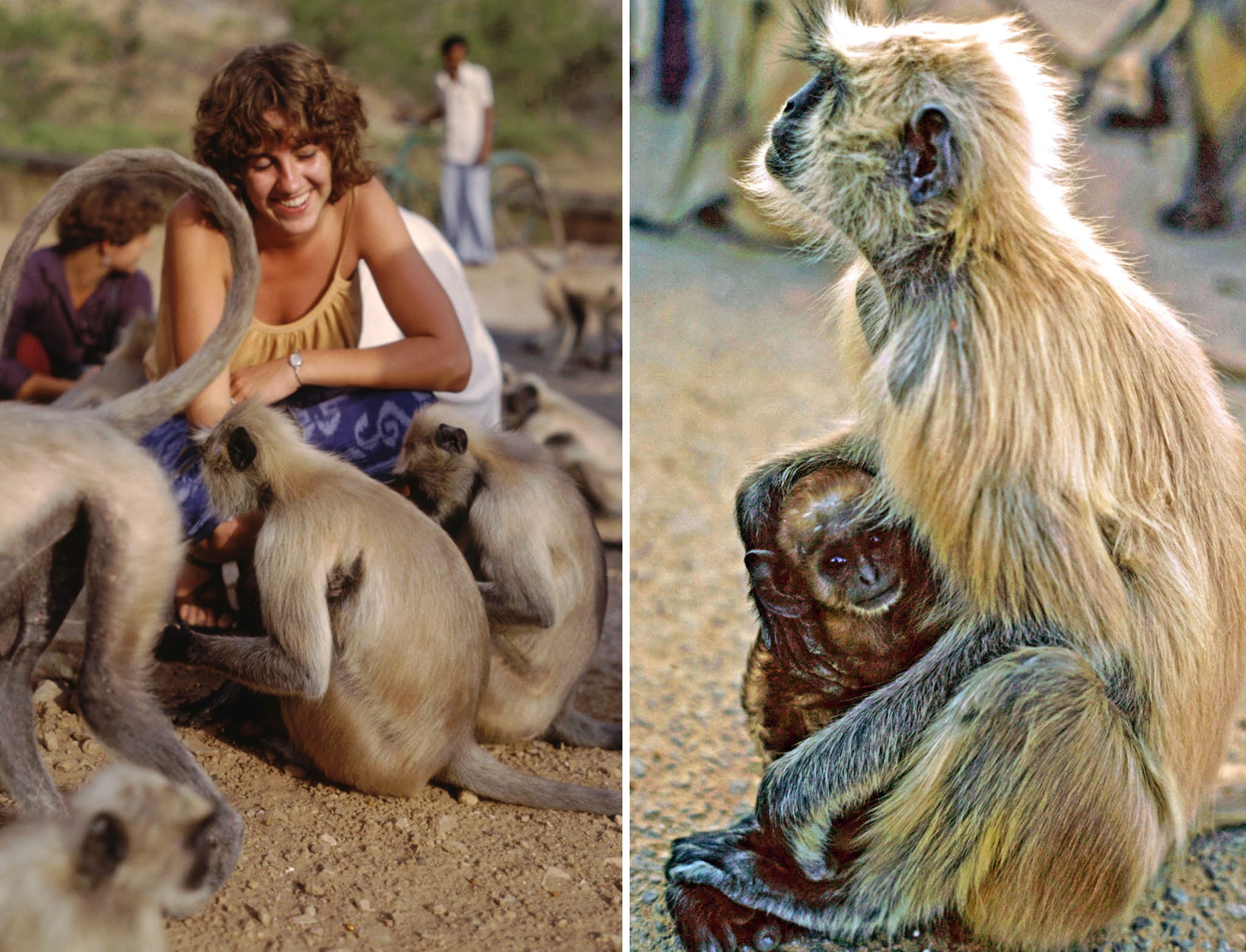
The Khloe Ke Hanuman Ji Temple, near Jaipur & langur monkey taunting a Brahmu bull!

Langur monkeys at the Hanuman Temple

As we approach Jaipur we will stop at the Khole Ke Hanuman Ji Temple dedicated to Hanuman the monkey god, where we will probably be mobbed by dozens of langur monkeys. Here we will meet Eugene Pram, our guide for the next two days in Jaipur. Eugene is a wealth of knowledge about Jaipur and will keep us entertained during our stay in the 'pink' city. Eugene will accompany us to Khetri House, a palace still owned by a minor Maharajah (of Ketri) who takes up residence here for a short while each year. Here we will be staying for the next two nights. Eugene will oversee a programme of entertainments for you tonight, over a few beers, or something a bit stronger!! 

Comments from the Passengers with their 'special' write up of the Party Games 

DID YOU KNOW THAT A CERTAIN GENTLEMAN ON THIS TOUR IS SO ATTACHED TO HIS MONEY BELT THAT HE GOES SWIMMING IN IT?  (I know, ‘cos I was there!)

“SPECIAL SUPPLEMENT”

PARTY GAMES AT JAIPUR 3-6-80

Order of events.  *(NB. The judges are unable to vouch for the validity of                                                                                                                                order of the events.)

1)    “The final of the Commonwealth bottle competition.”

WINNER:  Colin    ENG

(the 2 judges afterwards complained of distraction, as they were seated behind the competitors).

2)    “Indian Rope Trick”

The competitors had a little trouble with this event. However Ken and Carol, and the Canadian couple of Gail and John succeeded in this event. Jane and John required a little help from the referee. Pippa and Longjohn failed miserably at this event, and were eventually disqualified.

3)     The next two events involved Ken (ENG) who somehow succeeded in ruining both of them by

A.   Refusing to be levitated by four enthusiastic girls, and

B.    By negatively reacting to Eugene’s interference in the spoon game.

4)    There was a previously unadvertised event, whereby two young athletes took it upon themselves to see how long it would take to get a turban off a Sikh’s head. Unfortunately the result of this event cannot be published in the Guinness Book of Records, as the afore-mentioned turban was not of standard size.

5)   “Charades”. We are reluctant to declare a winner in this event since all participants displayed an obvious lack of dramatic talent. The judges feel they all lost!

6)   “Under the Sheet”. No doubt this was the highlight of the evening. The first competitor, Jane (AUS) utilised her power of perception by quickly offering the right article. However, the same cannot be said of the second competitor, Diana (ENG).

We, the judges, feel that at this particular time, a picture is self-explanatory: 


7)   “Concentrations”

Participants: Eugene and the latter competitor in Game 6 (My, what a busy evening she had).

In this event, Diana surprised us all with her artistic finger-painting ability. (Congratulations from us all).

8)   The evening seemed to degenerate rapidly after Game 7, consequently we will but mention three words:

SIMON                            SAM                                MOCKINGBIRD

9)  
The evening’s closing ceremonies began with Colin’s HAPPY HOUR, consisting of a variety of drinking games, which brought the few remaining participants into a condition parallel to Colin’s.


The site of the competitions was then transferred to the pool, where the few tenacious competitors entered enthusiastically into the frog-throwing event. The various categories included i) Johnny Woops ii) Repeatly throwing Carmen into the pool, and iii) Carmen’s laundry-orientated revenge.

The judges retired respectfully at 2am, but it is rumoured that events thrived until 4am.


Day 10    Wed 4 June                JAIPUR

  Departure time   8.30am                   Tach reading: 133,317            Distance run: 9 kms                                                                                  

Hawa Mahal, or Palace of the Winds, the zenana of the City Palace, Jaipur

    This morning Eugene will take us on a tour of the old 'pink' city of Jaipur. The city was painted pink in 1876, by order of Sawai Ram Singh I to welcome the Prince of Wales, who later became King Edward VII, and the city has remained pink ever since. Our tour will begin with the Palace of the Winds (Hawa Mahal). This is the zenana (women's quarters) of the City Palace, where the royal ladies, obeying the strict rules of purdah, could observe the everyday life in the streets below without being seen.


The City Palace of the Maharajahs of Jaipur

    The City Palace dates from the early 18th century when the city of Jaipur was founded by Maharajah Sawai Jai Singh II. He moved his court here from Amber in 1727.  Part of the City Palace is still used by the Maharajah of Jaipur and his family, and the other sections now house three museums  - a textile & costume museum, an armoury and a picture gallery. All three have interesting exhibits associated with the Maharajahs of Jaipur since the establishment of the city. 

Jantar Mantar, the Observatory of Maharajah Sawai Jai Singh II, Jaipur

    Perhaps the highlight of Jaipur is the amazing Observatory, known as the Jantar Mantar,  begun by Jai Singh II in 1728. This amazing series of instruments includes a giant sundial, the Samrat Yantra, which is the world’s largest gnomon (arm that casts a shadow) sundial, capable of measuring time in two-second intervals, using the shadow cast.  Other instruments include metal astrolabes;
Jaipur guide Eugene Pram making a point
at the Jantar Mantar

instruments enabling the observers to measure the zenith distance, declination and diameter of the sun; instruments that measure ecliptic coordinates of stars, planets and the 12 constellations and many other interesting constructions measuring the various coordinates of celestial bodies in azimuth and equatorial systems, etc.  - whatever all that means!! 
Jai Singh II also built similar observatories in Delhi, Mathura, Varanasi and Ujjain. Eugene gives a good indepth explanation of the workings of several of these fascinating instruments and it is a great place for photography.  


Street scene - decorated for Diwali - in downtown Jaipur

An adherent of Hanuman, the monkey gods, leaves a cart load of bananas for Jaipur's rhesus monkeys

    After the city tour we will return to the hotel and the afternoon will be free to shop or lie by the pool. In the evening Eugene has arranged for some Rajasthani puppeteers to perform their traditional art of entertainment at the hotel.

Crafts of Jaipur - enamelling, carpet weaving & Rajput puppets.


You may have noticed the large fort on the Aravalli hills overlooking Jaipur City.
This is the Tiger (Nahangarh) Fort, also built by Jai Singh II, in 1734.


Text & photographs ©Neil Rawlins 


Instagram accounts  @dustonmyfeet     and    @antipodeanneil

My paperbacks and ebooks on my Overland travels in Asia, Europe & Africa in the early 1970s and the experiences of a tour guide on the Asian Overland routes & leading Camel Safaris in Rajasthan in the 1980s are available from Amazon.