Featured post

Overland to London - Ephesus to Anzac Cove

  Celsus Library, Ephesus Day 87 (London Day 3)    Wed 20 August     EPHESUS – ANZAC COVE After a night-drive through from Pamukkale we a...

Monday, 9 August 2021

Overland to London - Varanasi to Agra

Local transport in rural Uttar Pradesh

Day 6    Sat 31 May VARANASI – KHAJURAHO

Departure Time:  6am Tach Reading  132,230     Distance run  392kms
     

We first cross the Ganges by the road-rail bridge, then head west towards Mirzapur. Shortly after Mirzapur the countryside changes as we climb a small range of hills. Lunch stop will be at Rewa, then we drive on through Satna to Khajuraho. 
Khajuraho is famous throughout the world as being the large temple complex of erotic sculptures

Kandariya Mahadev Temple & temple sculptures 


    These temples were built by the Chandela kings between 950 and 1150AD. The reason for this eroticism is obscure although it is thought to relate to a mystical Tantric cult where sex played an important role in their esoteric rites; where the Brahmin, or king spread his spiritual powers by way of intercourse with the women, much the same way as Rasputin did in the Court of the last Russian Tsar. Generally, the Hindu temple is also symbolic of the union between the earth (represented as a female) and the sky (represented as a male), as from this union all life springs. Eroticism in religious art in India is common on both Hindu and Buddhist temples and has its origins in earlier tribal cults of fertility. In Hinduism the temple represents the Cosmos, ‘where sky and earth embrace, and the marriage of Sky and Earth is re-enacted with the divine coupling of deities, or simply the love of ordinary mortals’ as represented in the Mithuna (sensuous couples amorously entwined) and Maithuna (couples in copulation or foreplay). [The Eye of Love in the Temple Sculptures of India by Richard Lannoy].

Erotic temple sculptures in Khajuraho

    All the temples have small areas of erotic art, both inside and out, but most of the sculptures depict scenes from the lives of the Chandela kings and the gods. The temples are dedicated to Shiva, Vishnu and their consorts. About two or three kilometres from the main grouping of Temples is a complex of Jain temples. These are worth a visit, if you are looking for a late afternoon or evening stroll. 

The Jain temple complex at Khajuraho

                We are staying tonight in the Khajuraho Ashok Hotel.  


 Day 7        Sun 1 June KHAJURAHO – AGRA

Departune Time: 7am     Tach reading  132,622     Distance run  398kms
       

Today we head through some interesting countryside as we drive towards Agra. The first

Once a common sight in India,
vultures around a dead water buffalo
major town we pass through is Jhansi, once the seat of a Maharajah whose queen, the Rani Lakshmi Bai, gained fame as a martyr against the British during the Indian Mutiny of 1857-8. The Rani was finally killed in action against the British during the final siege of Gwalior Fort in 1858. The Palace in which her room is a shrine to Indian Independence is at Orchha, just before Jhansi. Once past Khansi we will see from the road the interesting old palace at Datia and also several Jain Temples. 
The fort at Datia from the road


The Jains, or Jaina, are a small sect which arose in the 6th century BC after the Mahavira (an older contemporary of Gautama Buddha) rejected the authority of the Hindu Vedas. Jainism has 24 immortal saints (Tirthankaras) and its philosophy is based on the sacredness of life; even regarding plants as the brethren of mankind and refusing to kill even the smallest insect. The staunchest devotees wear mouth masks to avoid damaging even the microbes of the air.   
 

Gwalior Fort & the Jain statues


If we have time we will  drive up to the great fort at Gwalior, one of the largest in India which is situated on the top of a hill overlooking Gwalior city and the surrounding countryside. On the road approaches to the fort are a number of fine Jain statues, cut into the cliff face. Some of these statues of Jain tirthankaras are up to almost 20 metres in height. 


Many Indian states issued their own stamps
Before reaching Agra, we cross a rather dodgy pontoon bridge over the Chambal River - a new bridge is being constructed, the old having been swept away by the monsoon rains. 
As it is only a couple of days after the full moon, we may be able to visit the Taj Mahal this evening. I will find out if it is open when we arrive at the Jaiwal Hotel.


The temporary pontoon bridge over the Chambal River

Comments from passengers: "India is the most unprivate place I know. The waiters love coming in when you’ve only ½ dressed; never before have we had to eat mangoes, guzzle drinks, or go to the toilets before an audience of hordes of staring  Indians."

June 1 – a day of ironic events.

We stopped for lunch at a water hole – no water!

Our dream for air-conditioning came true when we watched the back window fall out – our cool air supply was more of a dust-storm!

Just when we thought Agra was going to to be 2 more hot hours away, we struck an oasis by the bridge and managed a quick dip – clothes and all.


Day 8 Mon 2 June AGRA

Departure time: 7.30am Tach reading  133,020 Distance run  38kms

The Red Fort on the banks of the Jumna River, Agra

    This morning a guide will accompany us, first, to the Red Fort of Agra built by Moghul Emperor Akbar the Great in the latter half of the 16th century. Here the last three Great Moghuls – Jahangir, Shah Jehan and Aurangzeb held court, and it was in a room overlooking the Jumna River and in sight of the Taj, that Shah Jehan spent the last 7½ years of his life, a prisoner of his son, Aurangzeb. From here the aging Shah Jehan could see the Tomb of his beloved queen, Mumtaz Mahal, which is our next place of visit.

The Diwan-i-Aam, the Moghul hall of public audience, Agra Red Fort

The Taj Mahal is rightly regarded as the world’s most perfect building. Perfectly symmetrical and with exquisite inlay work, it is probably the world’s most famous building and I’ve never known anyone on the tours to be disappointed with. The first time I saw the Taj, 10 years ago, it was cold and raining but still looked magnificent.  Mumtaz Mahal, Shah Jehan's favorite wife, died giving birth to her 14th child in 1631, aged just 38. It took her husband 22 years to complete the Mausoleum which now houses both of their bodies. Here the Moghul arts of architecture, marble-inlay and calligraphy, reaches perfection. 'Flowers were often used in Islamic and, in particular, Persian art and design as symbols of paradise. Persian poets described them as springing from the waters of paradise. Their use in the decoration of the Taj Mahal reinforced the message that the complex was intended to evoke an earthly paradise.' (Diana & Michael Preston - A Teardrop on the Cheek of Time: The Story of the Taj Mahal).

      It is interesting to note that in the early 19th century, a British viceroy wanted to demolish the Taj and send the marble to England, but the cost of doing this was considered too high. 

The incomparable Taj Mahal

    After visiting the Taj, the rest of the day will be free to, perhaps, swim in the pool of the Hotel Clark Shiraz, or visit the Jaiwal Emporium marble shop and see the old ‘Maestro’ of inlay, 85 year-old Mian Naqi Uddin (born 1895), at work with his apprentices. This old man is considered to be the greatest living worker of inlay marble whose work has surpassed that in the Taj, upon which he worked in the 1920s, carrying out repairs to the dome. According to a magazine article on Mian Naqi Uddin from the 1970s: 'The maestro's forte is said to be the cornelian stone. Mian Naqi Uddin is reputed to be the only man alive to make a perfect rose motif from this stone, reputed to be the hardest of semi-precious gems. He received his training under the strict tutorship of his father, Wazir Badshah.'

Mian Naqi Uddin, exponent of the art of inlay & an example of his work

    Across the Jumna River there is another beautiful tomb, often referred to as the ‘Baby-Taj’. This is the tomb of Itmad-ud-Daulah which pre-dates the Taj Mahal by 10 years. This tomb was commissioned by Nur Jahan, wife of the Moghul Emperor Jahangir, for her Persian father, Mirza Ghiyas Beg who had been given the title of Itmad-ud-Daulah (Pillar of the State) and who became Vizier in 1611, after Jahangir's marriage to Nur Jahan. Set in a traditional Moghul garden - symbolising Paradise, this tomb is a classic example of a domeless white-marble Moghul mausoleum which also boasts some fine marble inlay work. 

Tomb of Itmad-ud-Daulah & inlaid tilework

This evening I have arranged for the excellent Indian magician Parvez A. Warsi to perform on the hotel roof.

Minaret & white marble of the Taj Mahal


Text & photographs ©Neil Rawlins 


Instagram accounts  @dustonmyfeet     and    @antipodeanneil

My paperbacks and ebooks on my Overland travels in Asia, Europe & Africa in the early 1970s and the experiences of a tour guide on the Asian Overland routes & leading Camel Safaris in Rajasthan in the 1980s are available from Amazon.

Sunday, 8 August 2021

Overland to London - Bhairahawa - Varanasi


Laden elephant on the road to Gorakhpur


INDIA

Day 4.      Thu  29 May       BHAIRAHAWA – VARANASI

DEPARTURE TIME: 7.15      TACH. READING    131,883         DISTANCE RUN  313km

      Todays run takes us out of Nepal and into the large over-populated country of India,  - 1,269,291 sq.miles (3,287,263sq. kms), pop. 699 million (1980 figures - more than double that now - 2021). We enter India at the town of Sonauli and drive on into the State of Uttar Pradesh, India’s largest and most populated. There is a 15 minutes – yes, 15 minutes – time difference between Nepal and India. 

   The Nepalese formalities are usually over quickly, but with the Indians there is a definite procedure. We arrived at the Indian side of the border at about 9.30 and having collected all the passports I took them into Indian Immigration, while Gopher, the driver, brought in the appropriate coach papers. The head immigration officer, with appropriate head movements, looked at all the passports then pronounced: “Border is closed.” To which I replied: “No, no, it is only 9.30. Border open, not home time yet!” There was a slight pause, he looked at the stack of passports again, sighed, then said: “I not be having pen. Nothing to write with. Cannot do passports!” I was prepared for this. “Ah, I have pen here for you.” With a shrug of his shoulders he processed two or three passports, then looked up at me, then at his colleague who was sitting alongside doing nothing, and said: “My friend, he not be having pen. Two can work faster than one” With a sigh I said: “I have another pen here.” With head movements that only Indian officials can emulate, they processed a few more passports, then: “Chai? You have chai.” “OK” and after a few minutes cups of ‘chai’ (the sweetened milk tea popular in India) appeared and there was a break with appropriate small talk before the passport process continued, now a little quicker. I could see members of the group pacing up and down the muddy street outside, looking impatiently into the office. Eventually, all formalities were complete after about two hours and we were on our way. If one was arrogant or demanding, as some new tour leaders could be, the process could take twice as long. Patience and pleasantness always got things done quickly - by the standards of India.

          The route followed today is via Gorakhpur and Ghazipur to Varanasi on the River Ganges. Uttar Pradesh state, besides being the most populated, is also the most fertile. The western portion of the State, along with the Punjab, provides India with all its wheat and the Eastern part of the State, along with Bengal and Assam, with most of the country’s rice.

Temples by the side of the Ganges, Varanasi

          Varanasi, known to most Indians as Kashi,  is the sacred city of the Hindus, the city of Shiva. This is his perpetual abode where he and his consort Parvati (also called Shakti, Bhawani, Durga or Kali) live. The city is situated  on the confluence of two minor rivers, Varuna and Asi, with the mighty Mother river, the Ganges. Dr Raj Bali Pandey in Varanasi , the Heart of Hinduism expands on this: 'The 'Varuna' is associated with Varuna, the god of Waters and Morality. The word 'Asi' means a 'sword', a sword of knowledge, which cuts asunder, ignorance and bondage.' It was known by the British as Benares. It is here that the mighty Ganges curves in a huge sweeping bend on its journey from its source at Gomukh (the Cow’s Mouth), in an ice-cave in the Gangotri Glacier high in the Himalayas, to its multiple mouths in the Sundabans of Bangladesh in the Bay of Bengal. The Hindus have likened this great curve to the crescent moon, a symbol of the great god Shiva, and so the city has become ‘the perpetual abode of Shiva and his consort Parvati: every pebble being equal to Shiva.’ Here all devout Hindus come to bathe in the sacred waters of Mother Ganges at sunrise at least once in their lives and those who are lucky enough, or can afford it, are cremated on one of the two great cremation ghats on the riverbanks, and have their ashes scattered in the River.

 Day 5       Fri 30 May               VARANASI

                                            TACH. READING   132,196                  distance run  34kms

            An early start for a morning trip on the Ganges. As Varanasi is the holy city of the Hindus, all adherents to the faith try, at least once in their life, to make a pilgrimage to the city and bathe in the sacred waters of Mother Ganga. Time for the ritual ablution is at sunrise when Surya, the sun, ‘giver of life’, rises through the morning mists. Maximum spiritual benefit is obtained when the sun’s rays pass through the sacred waters of the Ganges as it is trickled from the devotee's hands held in prayer.

The sun rising over the Ganges, Varanasi

Devotees on the Bathing ghats at Varanasi

Early morning ablutions on the Ganges, Varanasi

        Just before sunrise we will walk down to one of the bathing ghats to board a row boat which will take us past the major bathing ghats and the Marnikarnika and Harishchandra cremation ghats and on past the conglomeration of Hindu temples along the river bank. Some of these temples are showing the effects of frequent inundations of the Ganges waters. We will also glide past the dhobi, or laundry ghat before heading, with our guide,  through the interesting back streets of the old city, to the golden Vishwanath (Shiva) Temple, the holiest in Varanasi, before we rejoin our coach.

Gliding in the early morning mists along the Ganges at Varanasi


Early morning on the dhobi or laundry, ghat, Varanasi


Dye sellers on the ghats, Varanasi


After breakfast, we will go to Sarnath, a settlement 10 kms from Varanasi, where Buddha preached his first sermon, known as the sermon in the Deer Park,  to his 5 disciples after he had attained enlightenment at Boghgaya.

Dhamekha Stupa at Sarnath

This is known as Dhammacakkappavattana Sutta, or the Setting in Motion of the Wheel of Dharma. Here at Sarnath is a modern Buddhist temple and the ancient Dhamekha Stupa built over the spot where Buddha preached; the ancient ruins of Sarnath and an archaeological museum which houses the famous Lion capital of King Ashoka, now the emblem of India. N.K. Sharma, in his book Varanasi: City of Burning & Learning describes the lions: 'They represent non-violent Buddha symbolically roaring the doctrine of peace, to the four directions of the world. India is proud of over (sic) this sculpture and has taken it as the national symbol of India which means that the constructor of this wonderful piece, the mighty emperor Asoka, 300 years before Christ, had the policy of peace to which India cherishes upto the time (sic).'  From Sarnath we will visit a silk factory before returning to the Hotel de Paris.

Later in the afternoon I will arrange for snake-charmers and a yogi to perform on the lawn of the Hotel de Paris. 

Yogi-man in 'resting position', Hotel de Paris lawn

Snake charmers with their cobras, Hotel de Paris lawn

In the evening a sitar and tabla player from the Varanasi Academy of Indian Classical Music will put on a performance at the Hotel. The sitar is the stringed instrument made famous by Ravi Shankar and used on one or two of the Beatles tracks, the tabla is a small hand drum which often accompanies the sitar

Tabla accompanying the sitar, Hotel de Paris


Hinduism

As we are in Varanasi, India’s holiest city, I will now write a few words on Hinduism, the world’s oldest religion still in existence. The beginnings of Hinduism are lost way back in the mists of the ancient Indus Valley Civilisations which flourished on the sub-continent in the 2nd Millennium BC. These early peoples had a sophisticated image cult that embodied many aspects of present day Hinduism. Then came the Aryan invasions from Central Asia and with these people came the Vedas of which the Rig Veda is the oldest. Throughout the centuries the religion developed and was reformed until, finally, becoming the extremely complex faith that it is today.

Hindu trinity - Brahma,
Vishnu & Shiva as one

At its highest level, known as Brahmanism, belief is in a subtle and sophisticated monotheism in which Brahman is an impersonal all-embracing spirit, although there is a tolerant acceptance of more primitive beliefs. The Absolute, or Infinite, the Brahman, has three aspects, personified in the ‘Hindu Trinity’, or Trimurti: Brahma, the creator; Vishnu, the preserver; and Shiva, the destroyer.

The two great doctrines of Hinduism are karma and transmigration. The universal desire to be reunited with the absolute (atman or Brahman) can be satisfied by following the path of knowledge. Life is a cycle of lives (samsara) in which man’s destiny is determined by his deeds (karma) from which he may seek release (moksa) through ascetic practices or the discipline of Yoga. Failure to achieve release means reincarnation – migration to a higher or lower form of life after death – until the ultimate goal of absorption  in the Absolute is reached.

The Hindu Trinity, Brahma, Vishnu and Shiva are all interesting characters. Brahma the creator is usually depicted with four heads and is carrying the Vedas. Although the Creator, Brahma is not as powerful as the other two gods who often have to intervene in situations to help Brahma out. Sarasvati, the goddess of learning, is his consort.

Vishnu, the preserver, is also interesting in that every so often he has been reincarnated to help the human race. There are 10 major avatars (incarnations) of Vishnu, each with its own story: i) Matsya, the fish; ii) Kurma, the tortoise; iii) Varana, the boar; iv) Narasinha, the man-lion; v) Vamana, the dwarf; vi) Parasurama, the prince with an axe; vii) Ram, the feudal prince and hero of the Indian epic poem the Ramayana; viii) Krishna, the divine lover; ix) Buddha, the great teacher; and x) Kalki, the avatar yet to come. Vishnu’s consort is Lakshmi, goddess of wealth. It is Lakshmi who stimulates Vishnu by tickling his feet as he lies asleep on a serpent upon the cosmic ocean. 

Narasinha avatar tears in half the demon Hinranyakashipu; Krishna enchants the milkmaids & Saraswati, consort of Vishnu

As Lakshmi stimulates Vishnu, the male energy is released. Vishnu dreams and a lotus grows out of his navel, upon which is seated the creator, Brahma, carrying the Vedas. And thus, the process of creation is instituted.

Shiva, the destroyer, is often regarded as the most powerful. He is Vishwanath, the Lord of the Universe. He has two forms, a manifest form in which he is represented as the ascetic with matted locks from which the Ganges springs; and an unmanifest form in which he is worshipped as a lingam (a phallic symbol). Other forms of Shiva are Nataraja – the King of the dancers, and in his destructive aspect as Rudra, or Black Bhairab (Kathmandu), the terrible. His consort is Parvati who, in her docile form is the perfect wife; in her terrible Shakti aspect she is Durga or Kali, the goddess of death.


Aspects of Shiva. A Shaivite sadhu, or holy man; Black Bhairab of Kathmandu; & a Shiva lingam, the phallic symbol


All these different aspects of the gods are extremely complex. There are many other lesser gods, the two best known being Ganesha, the anthropomorphic elephant-headed god of beginnings, the patron and learning and letters & the protector of the household; another is Hanuman, the monkey god, companion of Rama, and god of wisdom, strength, courage and devotion. Other gods include Surya, the sun god, Vayu, the wind-god and Agni, the fire-god.  

Shiva, with Ganga entwined in his hair

Before finishing, a word should be said about the River Ganges, or Ganga Mai – Mother Ganges. The river is personified as a goddess sitting astride a crocodile. The Ganges is 1560 miles long beginning in an ice-cave known as the Gomukh or Cow’s Mouth, situated over 12,500 ft up in the Himalayas, at the foot of the Gangatri Glacier. The icicles in the ice-cave are regarded as being the frozen dreadlocks of Shiva, from whose head the Ganges springs. From the source, the Ganges flows across northern India to its mouth in the Bay of Bengal at Calcutta (Kolkata) and the Sundarbans of Bangladesh. Pilgrimage from the source to the mouth is called Pradakshina and is done by prostration, taking 6 years to complete. Every Hindu should bathe at least once in the river, and to say the words: ‘O Ganga, o Ganga” with love will atone for misdeeds in three previous incarnations.


Text & photographs ©Neil Rawlins 


Instagram accounts  @dustonmyfeet     and    @antipodeanneil

My paperbacks and ebooks on my Overland travels in Asia, Europe & Africa in the early 1970s and the experiences of a tour guide on the Asian Overland routes & leading Camel Safaris in Rajasthan in the 1980s are available from Amazon.

Saturday, 7 August 2021

Overland to London - Crossing the Narayani River


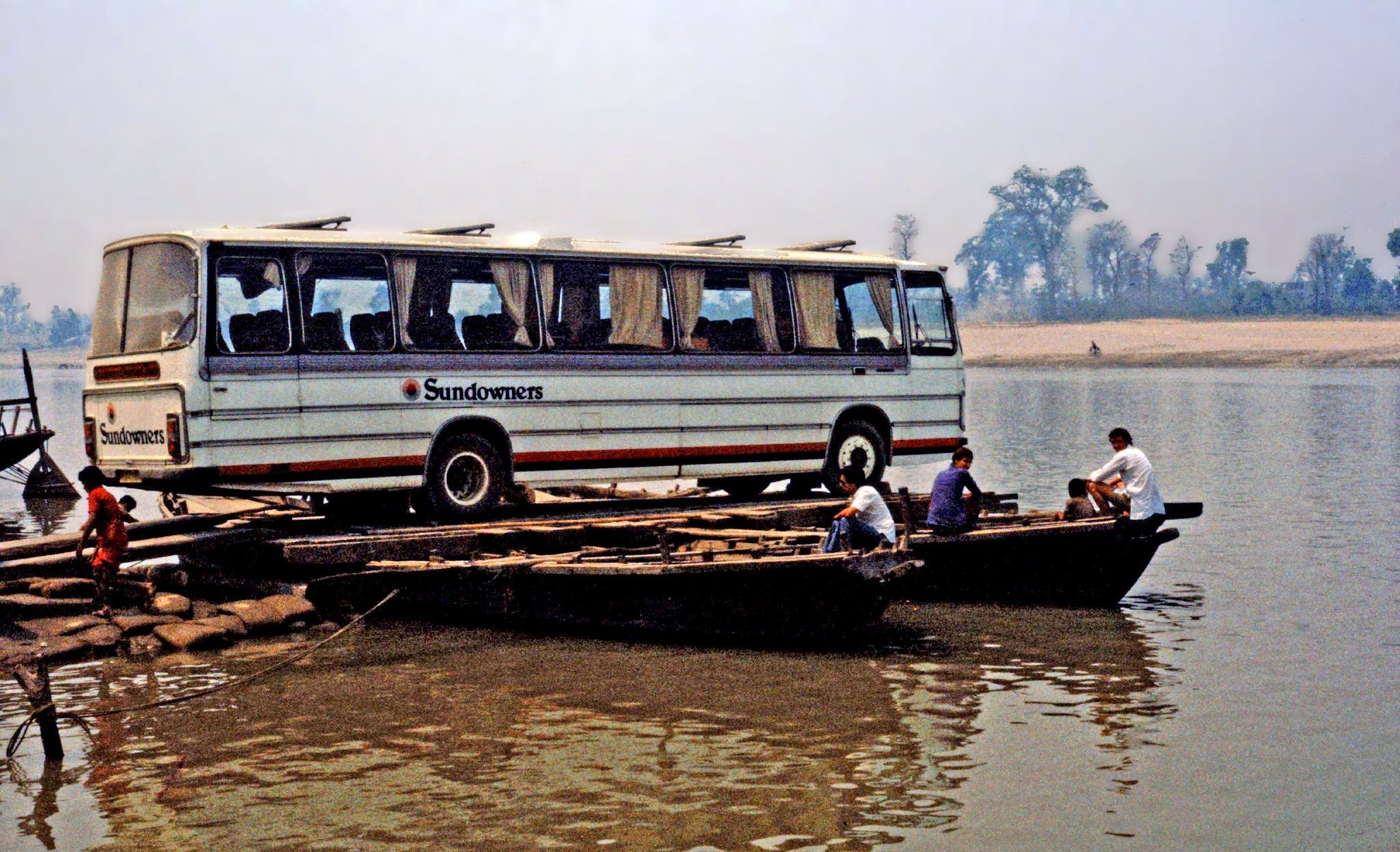
 On my last Overland in March 1982, with Mr Sid in the Ford coach PBA, we were told in Pokhara that our normal route south to Bhairahawa via Tansen had been cut by a number of landslips and we would have to take an alternative route. This meant back-tracking towards Kathmandu as far as Mugling, then taking the newly-constructed highway to Narayanghat on the Narayani River.
At Narayanghat a new bridge was being constructed over the Narayani River as part of the new Mahendra Highway project and we would have to cross the river by a local man-powered ferry. This basic ferry was made up of two open deck boats with a section of heavy 'wooden' highway holding the two boats together. Motive power was by a couple of large oars and a rudder. 


Mr Sid and I watched a local bus being loaded and Sid formed his plan of attack - not that we had much choice. We watched the ferry depart and noted the landing point on the opposite bank, which was almost directly opposite us. 

The ferry returned and it was our turn. Sid knew that he would have to use all his driving skills to place our 'over-sized' coach, which  had a longer wheel-base that the local vehicles, exactly on the boards on the two boats to keep the equilibrium. We both scientifically measured the length of our coach and the wooden platform by pacing the length of each - probably with different results. "Right,' said Sid, 'let's do it!'  An Indian stood in front of the coach beckoning Sid forward but Sid didn't trust him and asked me to squat down and make sure the wheels were placed on the thickest boards and to stop him when the front wheels were close to the gunwale of the left boat. We reckoned that the coach would, then, more or less, be evenly balanced - and so it proved!


 Sid made sure the coach was parked effectively - brake on, in gear -  on the ferry, got out and we both  hoped for the best. I went back to where the passengers were watching and made arrangements for them to cross the river on a separate passenger ferry. 
 

With Sid now sitting in the bow, the ferry cast off, with the oarsmen keeping the vehicle and its unwieldy charge, reasonably close to the right bank, letting the counter-current take the ferry up-stream. 

I, along with the passengers watched as the counter-current took the ferry further and further up-stream.. Did those turkeys know what they were doing?!!


Just as we were fully expecting to see PBA slip beneath the waters of the Narayani River in imitation of the Titanic and the passengers were checking to see if their travel insurance included losing their luggage in a 'sinking at sea' in the middle of Nepal, the ferry reached the main stream, changed direction and began picking up speed. We could see the crew struggling with their oars and the rudder, and their were sighs of relief when we saw the ferry stop exactly at the landing opposite us. The ferry crew knew exactly what they were doing. 


Now in a more cheerful frame of mind, the passengers and I climbed onto the passenger ferry to join Sid who was now looking happily relaxed  and we were on our way to Bhairahawa, and a chicken curry dinner.

Text & photographs ©Neil Rawlins 


Instagram accounts  @dustonmyfeet     and    @antipodeanneil

My paperbacks and ebooks on my Overland travels in Asia, Europe & Africa in the early 1970s and the experiences of a tour guide on the Asian Overland routes & leading Camel Safaris in Rajasthan in the 1980s are available from Amazon.

Friday, 6 August 2021

Overland to London - Kathmandu to Bhairahawa

 
Rice padis in the Nepalese countryside

NEPAL

 Day 1.  Mon 26 May           KATHMANDU – POKHARA

  DEPARTURE TIME   8AM      TACH. READING: 131,499       DISTANCE RUN  200kms                                                                                        

    Today's drive is a little over 200kms but because of the condition of the road, will take us around 6 hours. Shortly after leaving Kathmandu city we come to the stretch of road that is known as the Tribhuvan Raj Path (commonly called just the Raj Path  - Tribhuvan being the name of the present king’s grandfather who deposed the powerful Rana family and restored the monarchy to Nepal in 1951). At the summit of the Raj Path, it is interesting to compare the height of the Kathmandu Valley with the lands beyond. Now begins a descent along a road that at present is under construction. This is the worst road of the entire Overland. It is also something I feel that every road construction worker in the Western world should see.  
Locals on the Tribhuvan Rajpath out of Kathmandu

    The entire operation, even down to the breaking up of the stones, is done by hand. The only heavy equipment you see here, are a few road rollers. This stretch, from the top of the Raj Path to the Pokhara turn-off at Naubise will take us about ¾hour to negotiate the 15kms or so. The rest of the run to Pokhara is through pleasant hill country with villages and spectacularly terraced rice fields. We follow several river valleys that drain the land and are tributaries of the Ganges. You often see Hindu cremations on the banks of these rivers. Pokhara, like Kathmandu, is situated in a valley and from here, especially in the early morning, you get good views of the Annapurna Range and Mt. Machhupuchhre (Fish-tail Pk). Pokhara is also the most important trekking centre in Nepal. We stay tonight and tomorrow at the Hotel Annapurna, by Pokhara Airport.

 
Roadworkers breaking rocks in the village of Mugling on the road to Pokhara


Day 2       Tues 27 May             POKHARA
 Free time in Pokhara. Pokhara lies in a valley 2,900 ft above sea level at the foot of the Annapurna Range, which is some 18 miles away. Despite of the area’s nearness to these 26,000ft peaks, the valley is tropical, never seeing snow at any time during the year. Near Pokhara is Lake Phewa, a small but rather attractive lake on which canoes are readily available for hire.

Canoes on Lake Phewa, Pokhara

     One popular walk in the area is that up a neighbouring hill called Sarankot which overlooks the lake. Also in the area is a Tibetan refugee camp and Mahendra Caves, some 7 miles distance. The best times to view the mountains is normally at sunrise from the roof of the hotel. 

Annapurna & Machhupuchhre (Fishtail) from the Hotel Annapurna, Pokhara

   From left to right the peaks are: Dhaulagiri (8167m) in the distance, South Peak (7273m), Hiunchuli (6333m), Annapurna I (8091m), Mardi Himal (5555m) Machhupuchhre, or Fishtail Peak (6997m), Gangapurna (7454m), Annapurna III (7555m), Annapurna IV (7525m), Annapurna II (7937m) and Lamjung Himal (6986m).

The snowline is normally at 5366 metres.
This evening I have arranged a Tibetan meal at the Hotel followed by a Tibetan cultural show, put on by the children from the refugee camp. Tibetan beer – chhang – will be served!   Chhang is a local rice beer, cloudy white in appearance with an interesting, but not (at least to me) unpleasant taste.

Comment from on of the group: I liked the beer!  (even though it tasted like fermented cod liver oil)


Day 3       Wed 28 May             POKHARA – BHAIRAHAWA

DEPARTURE Time    8am            TACH READING   13,699             DISTANCE RUN  184kms
                                                         
 Today’s drive is still through the Himalayan foothills, passing many of the small villages we have already become familiar with. Will stop for a break at the village of Tansen. Just before we leave the foothills we will be stopping for a swim in a mountain pool just off the roadside (Bhoot Khola). Shortly afterwards we reach the area of the Indo-Gangetic Plain known as the Terai. This is the only flat area of Nepal and until 20 years ago, was virtually
A dip in Bhoot Khola

uninhabitable due to the prevalence of the malaria-carrying mosquito. After the success of the malaria eradication programme, much of this fertile flat land has been brought into agriculture. As with the highlands, rice is the predominant crop. Our night stop in the border town of Bhairahawa (now called Siddharthanagar), is in a hotel that would be the worst that we will stay in in this part of the world. This is the Hotel Lumbini. There will be a chicken curry for dinner tonight. Do not be surprised in you are in the bar and hear the squawking of a chicken cut off abruptly. It will just be the first stage in the preparation of dinner!  In the morning you will notice many locals heading into the fields around the hotel, and squatting down with little brass bowls. They are not weeding their petunia patch, but are performing the far more practical business and increasing the fertility of their fields! According to the French Jesuit missionary, Abbé DuBois in Hindu Manners, Customs & Ceremonies, there were 22 rules of defecation for a Brahmin beginning with "Taking in his hand a big chembu (brass vessel) he will proceed to the place set apart for this purpose, which should be at least a bowshot from his domicile.” and ending with: "He will think three times on Vishnu and will swallow a little water three times in doing so."

 Buddhism

          Near Bhairahawa – about 25 kms away is Lumbini which is regarded as being the birthplace of Gautama, the Buddha in the 6th century BC. Siddhartha Gautama was originally a prince of this area and, becoming concerned by the problem of human suffering, he left his palace, wife and child to become an ascetic. After 6 years of studying the beliefs of Brahmin hermits and self-torturing recluses without success, he one day sat down under a tree (the Bo-tree at Bodhgaya in India) and finally came to understand the cause and cure of suffering. The basis of the Buddhist religion are thus enshrined in the ‘Four Noble Truths’ which are:


i)              That existence is unhappiness
ii)            That unhappiness is caused by selfish desire or craving
iii)           That desire can be destroyed
iv)           That it can be destroyed by following the ‘noble eightfold path’.
The golden Buddha at Lumbini


Whose steps are: right views; right desires; right speech, plain and truthful; right conduct including abstinence not only from immorality but also from taking life, human or animal; right livelihood, harming no one; right effort, always pressing on; right awareness of the past, the present and the future; and lastly, right contemplation or meditation. The more man acquires merit by following these rules in his chain of lives, (A Buddhist believes in the Hindu doctrine of a cycle of lives), the sooner is Nirvana attained; he loses his individuality, not by annihilation, but “as the dewdrop slips into the shining sea,” by merging with the universal life.
          Buddhism teaches the way pf liberation through ethics and discipline and a universal god plays no part in this religion. 
          There are now various sects of Buddhism. Mahayana, or the Greater Vehicle, is practised in Nepal, Bhutan, Burma, Thailand and Hinayana, or the Lesser Vehicle, in Sri Lanka. The Tibetan form in called Lamaism and gods from the ancient Tibetan Bön religion often feature in ceremonies. The Dalai Lama is the spiritual head of Lamaism. In Japan, Shintoism is a form of Buddhism, as is Zen.
          At Lumbini, nowadays, are a couple of monasteries, a temple with a golden Buddha, ruins and an Ashoka Pillar, built by King Ashoka, the great Buddhist king of India in the 3rd century BC, which proclaims the site as being the birthplace of Gautama.

Text & photographs ©Neil Rawlins 


Instagram accounts  @dustonmyfeet     and    @antipodeanneil

My paperbacks and ebooks on my Overland travels in Asia, Europe & Africa in the early 1970s and the experiences of a tour guide on the Asian Overland routes & leading Camel Safaris in Rajasthan in the 1980s are available from Amazon.